

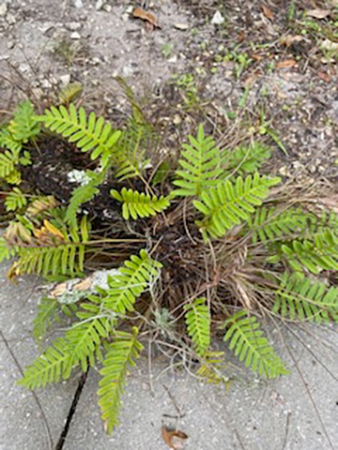
As you walk along the Verandah nature trails, glance up and you may see the most interesting and unusual fern growing along the branches of Live Oak trees. This fern has the unique ability to revive or ‘resurrect’ itself. During dry weather the 4–6-inch fronds of the fern curl and shrivel, appearing dead. After a rainfall it will magically come alive with lush green fronds. Thus, the term ‘Resurrection Fern.’
Like Spanish moss, resurrection fern (Pleopeltis polypodioides) is an epiphyte, receiving its nutrients from air and water. It creeps along the limbs of oak, cypress, elm and magnolia trees, using the branches for support only. The coarse texture of the tree’s bark provides an ideal surface for the short, wiry, rhizomes(roots) to anchor and grow.
Resurrection ferns can survive long periods of drought. During the dry season, they lose about 75% of their water but can lose up to 97% and still be alive. In contrast, most plants die after losing 8-12% of their water. Researchers believe that this fern can remain dormant for 100 years and still resurrect.
The fern is native to Florida and areas of the southeast. It reproduces by tiny spores located on the underside of their leaves that are carried by wind. New plants can also spread by plant division.
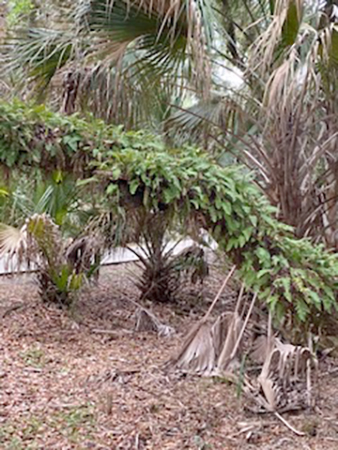
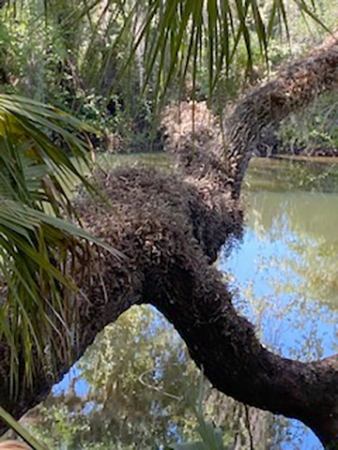
Throughout history, the resurrection fern has made its mark. Indigenous people used it to treat mental illness, sick infants, heart conditions, infections, and as a diuretic. It’s been recorded that the Seminole used the fern in baths to treat insanity. In 1997, it was taken in space on the Space Shuttle Discovery, earning the title ‘first fern in space’. The experiment was to see if the fern resurrected in zero gravity. The result, yes, it does. The attached before and after photos of the resurrection fern were taken on the section of the Verandah Nature Trail that runs from River Point to the Clubhouse