


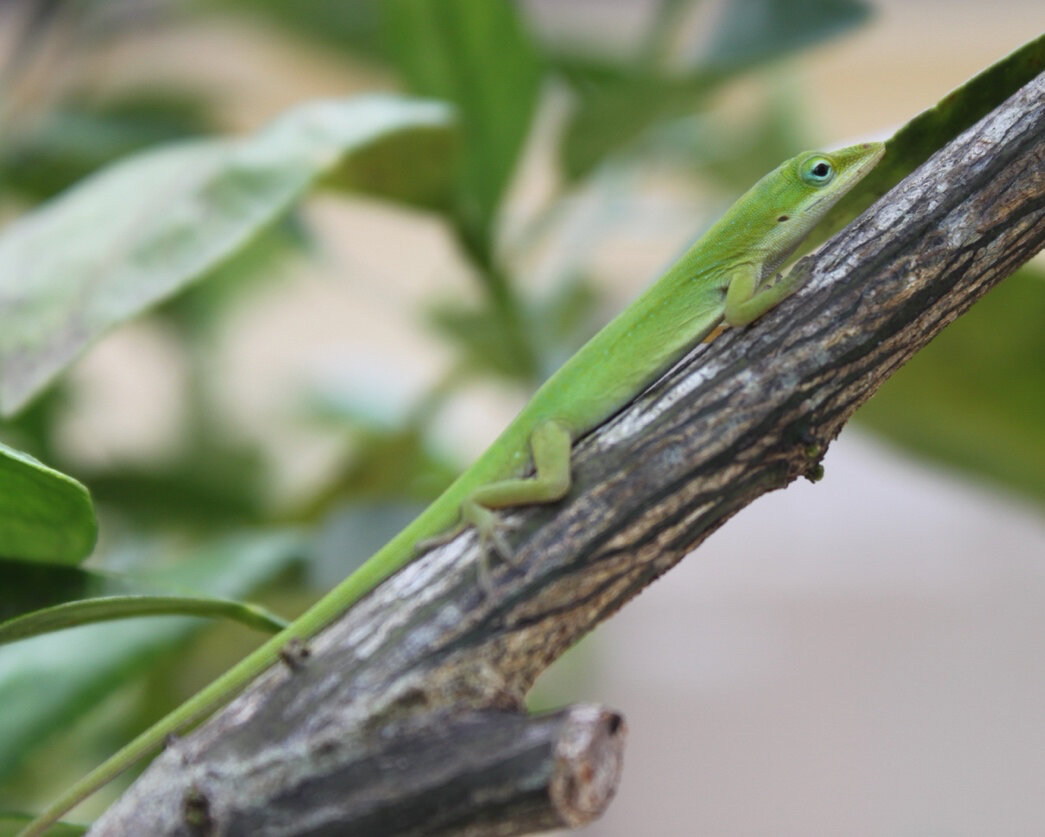
We share our community with an abundant variety of wildlife. Among the most common is the anole (pronounced uh-NOLE-ee). These tiny lizards are a familiar sight throughout Verandah, whether they’re perched on your lanai screen, racing across sidewalks, or climbing trees and shrubs in search of insects.
Many people mistakenly call anoles geckos or even chameleons, but they are neither. While geckos are also small climbing lizards, most geckos have broader heads, large lidless eyes, and are primarily active at night. Anoles are typically active during the day and have a different body shape and behavior. They are also not chameleons. Although green anoles can change from green to brown, they do not have the dramatic color-changing abilities of true chameleons. Their color changes are influenced by temperature, light, stress, and social interactions rather than an attempt to blend into specific backgrounds.
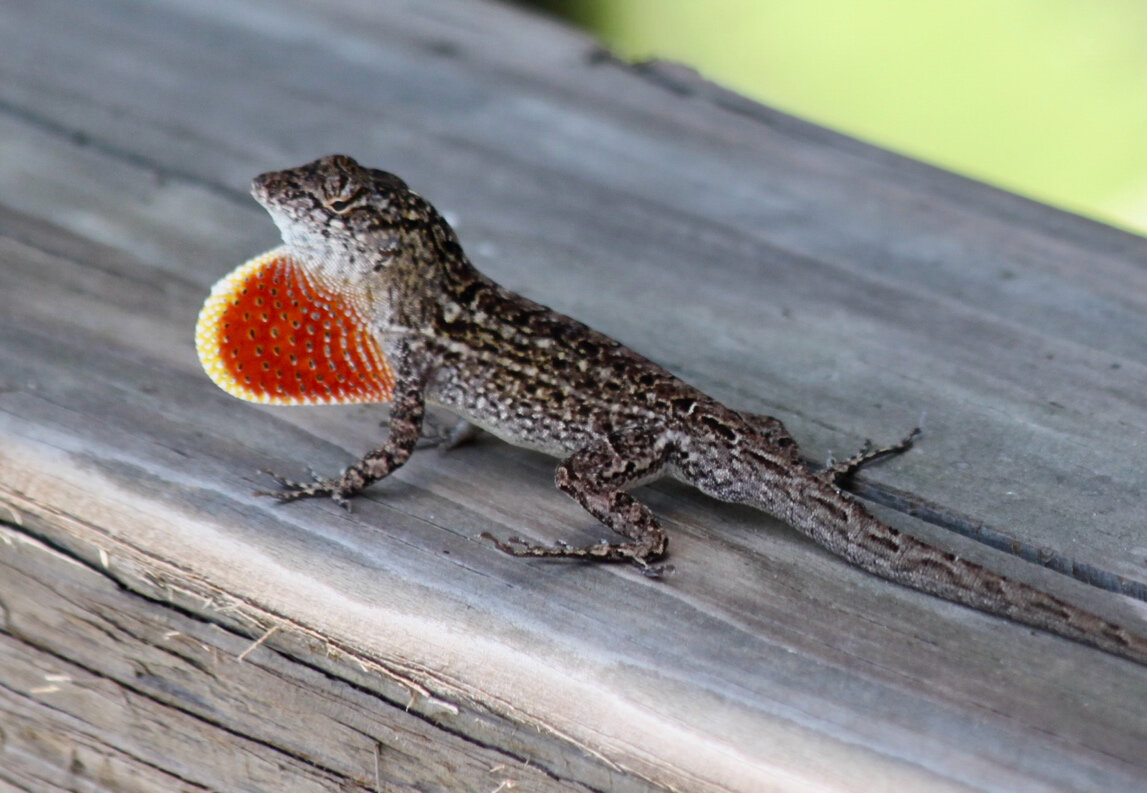
The most common species in our area is the brown anole (Anolis sagrei), originally native to Cuba and the Bahamas but now widespread throughout Florida. The native green anole (Anolis carolinensis) can also be found here, although it is often less common than its brown cousin. As the brown anoles spread through Florida, green anoles adapted by spending more time higher in trees and shrubs which is why you don’t see as many green anoles.
Male anoles are especially entertaining to watch during the breeding season. They perform elaborate displays by extending a colorful throat fan called a dewlap. This flap of skin, usually pink, orange, or red, is combined with a series of dramatic head bobs and push-ups designed to attract females and warn rival males to stay away.
Anoles are also skilled climbers. Their clawed toes are equipped with tiny adhesive pads covered in microscopic hair-like structures that allow them to cling to walls, tree bark, and even windows.
These little reptiles play an important role in our ecosystem. Anoles are insect-eaters, feeding on ants, flies, mosquitoes, beetles, spiders, and many other small invertebrates. A healthy anole population helps keep insect numbers in check around our homes and gardens.
Anoles themselves are an important food source for larger animals. Birds, snakes, raccoons, and other predators all rely on them as part of the food web. To escape danger, anoles have a remarkable defense mechanism: they can shed their tails. The detached tail continues to wiggle and twitch, distracting the predator while the lizard makes a quick getaway. Although the tail eventually grows back, it is never quite the same as the original.
They may be tiny compared to Florida’s most famous reptile—the alligator—but anoles are just as fascinating in their own way. From their impressive climbing skills to their head-bobbing displays, push-ups, and colorful dewlaps, these little lizards remind us that some of nature’s most interesting species come in the smallest packages.
10 INTERESTING FACTS ABOUT ANOLES
1. Florida’s native green anole is the only anole species native to the southeastern United States.
2. Anoles can move each eye independently, helping them watch for both prey and predators. They have excellent eyesight.
3. A male’s dewlap is unique to its species and acts like a visual signal flag where brown anoles signal to other brown anoles and green anoles signal to green anoles.
4. Brown anoles are often seen lower on tree trunks and on the ground, while green anoles tend to occupy higher branches and shrubs.
5. Anoles are cold-blooded and spend much of the day moving between sun and shade to regulate their body temperature.
6. A newly regrown tail contains cartilage rather than the original vertebrae.
7. Anoles can leap surprisingly long distances relative to their body size, helping them move quickly through vegetation.
8. If you look closely, you’ll notice that no two anoles have exactly the same markings. Brown anoles often display a zigzag, diamond, striped, or mottled pattern down their backs, while many females have a distinctive light stripe bordered by darker markings. These patterns help break up the lizard’s outline among leaves, bark, and shadows, making them harder for predators to spot.
9. Not every small lizard you see is an anole. If the lizard has shiny, smooth scales and looks almost snake-like, it’s probably a skink. If it has rough, spiny scales and spends most of its time on tree trunks or fences, it may be a fence lizard.
10. Although they may look very different, anoles and iguanas belong to the same major branch of the lizard family tree. You can think of anoles as miniature relatives of the much larger iguanas.