

THE BOAT-TAILED GRACKLE: VERANDAH’S BOLD AND BOISTEROUS BLACKBIRD
Whether you are inside Verandah or walking to your car in the Publix parking lot, you have almost certainly encountered a Boat-tailed Grackle. These large, long-legged birds strut confidently across lawns and parking lots, announcing themselves with an assortment of whistles, rattles, clicks, and squeaks. They may not have the sweet song of Verandah’s songbirds, but they certainly know how to make their presence known!
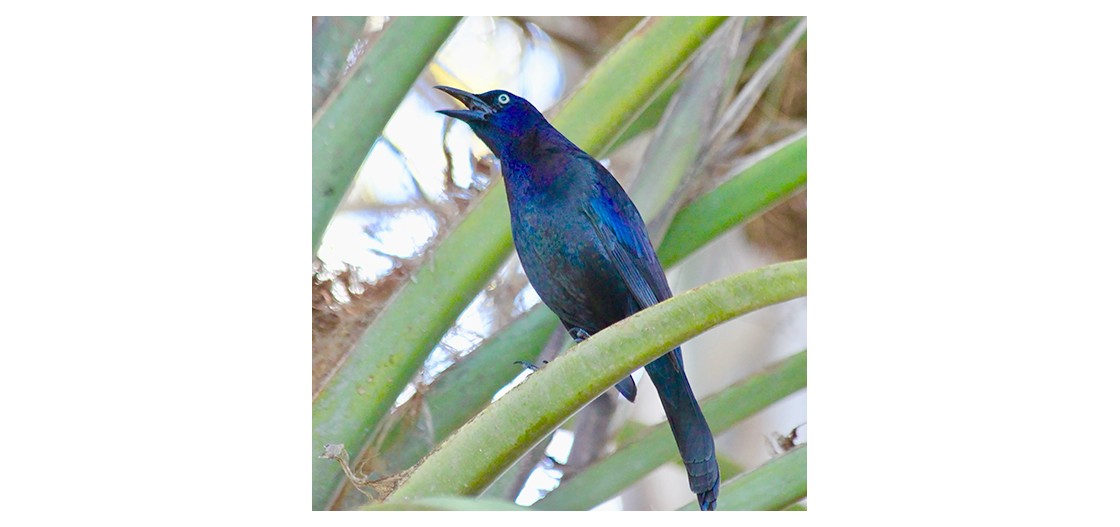
Males are glossy black, but in bright sunlight their feathers shimmer with iridescent shades of blue, purple, green, and bronze. Their pale yellow eyes give them an especially intense expression. The female looks so different that you might mistake her for another species. She is considerably smaller, with brown feathers, darker wings, and a shorter tail. This striking difference between males and females is called sexual dimorphism. Juvenile grackles resemble the females until the young males gradually develop their glossy black plumage.
Boat-tailed Grackles are opportunistic feeders—a polite way of saying they will eat almost anything. Their natural diet includes aquatic insects, grasshoppers, caterpillars, tadpoles, frogs, small fish, seeds, berries, and grain. Grackles have also become skilled at living around people. They patrol parking lots, picnic areas, restaurant patios, and trash containers in search of easy meals. One may wait patiently near your table, hoping you will drop a crumb—or turn your back on a French fry! Although feeding grackles may be tempting, human food is not healthy for them. Leaving them to find their natural foods is best for both the birds and people.
Male Boat-tailed Grackles are enthusiastic performers. During breeding season, a male perches where he can be easily seen, fluffs his feathers, spreads his impressive tail, points his bill upward, and rapidly flutters his wings. He accompanies this display with loud, mechanical-sounding calls. The message is intended for two audiences: “Look at me!” to the females and “Stay away!” to competing males. Several males may display and challenge one another, but the highest-ranking male usually guards a group of nesting females.
Females do all the nest building. A female weaves grasses, leaves, twigs, Spanish moss, and other plant material into a bulky cup, often adding mud to strengthen it. She usually places her nest in cattails, sawgrass, shrubs, mangroves, or small trees near water. She also incubates the eggs and feeds the nestlings without assistance from the male. A typical clutch contains two to four eggs.
Boat-tailed Grackles are highly social birds. They often gather in noisy flocks. Their vocalizations may not sound musical to us, but grackles use these calls to communicate warnings, defend territory, attract mates, and maintain contact with one another. These adaptable birds are also keen observers. They quickly learn where food is likely to appear, when people are nearby, and which situations are safe. Their boldness has allowed them to thrive alongside humans.
The next time you spot a glossy black bird striding across a Verandah lawn with its long tail held high, stop and take a closer look. Notice the rainbow of colors hidden in its “black” feathers. Listen to its unusual vocabulary. Watch how cleverly it searches for food. The Boat-tailed Grackle may be noisy and always on the lookout for an unattended snack—but it is also a fascinating Verandah bird perfectly suited to life beside our waters and among our residents.
TEN INTERESTING FACTS ABOUT BOAT-TAILED GRACKLES
1. The Boat-tailed Grackle gets its name from the male’s unusually long, V-shaped tail. When held upright or spread in flight, the sides of the tail curve upward like the hull of a boat.
2. Boat-tailed Grackles belong to the blackbird family, along with orioles, meadowlarks, cowbirds, and bobolinks.
3. Florida is one of the few places where Boat-tailed Grackles commonly live far from the coast.
4. Their calls resemble squeaky gates, rusty hinges, whistles, rattles, and mechanical clicks.
5. Their pale blue-green eggs are covered with unusual brown and black scribbles.
6. They sometimes dunk dry foods such as bread, rice, and dog food in water before eating them.
7. They can pry open mussel shells and remove snails from their shells.
8. The oldest recorded Boat-tailed Grackle was a female at least 13 years and 1 month old. She was recaptured and released by a bird bander in South Carolina in 2003.
9. A male’s feathers are not actually blue, purple, or green. Tiny structures in the feathers reflect and scatter light at different angles, creating the shimmering iridescent colors we see.
10. Most Boat-tailed Grackles remain throughout their lives within about ten miles of the area where they hatched.