


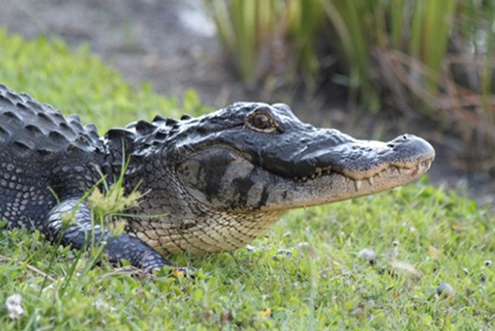
If you’ve walked along our boardwalks, ponds, or fairways in Verandah, you’ve likely noticed one of our iconic Florida residents—the American alligator. Sometimes they are floating like a dark log with only their eyes and nostrils showing. Other times they’re stretched out on the grassy banks, soaking up the sun. Living in Verandah means sharing our beautiful environment with these ancient reptiles and understanding them helps us enjoy our community safely and confidently.
American alligators have changed very little over millions of years. They are large reptiles with armored, scaly bodies, powerful tails, and broad, rounded snouts. Their coloration—usually dark gray or nearly black with a light colored belly—helps them blend into the murky waters of our ponds and rivers. Although they can look slow or sleepy when resting, they are capable of short bursts of surprising speed, especially in the water.
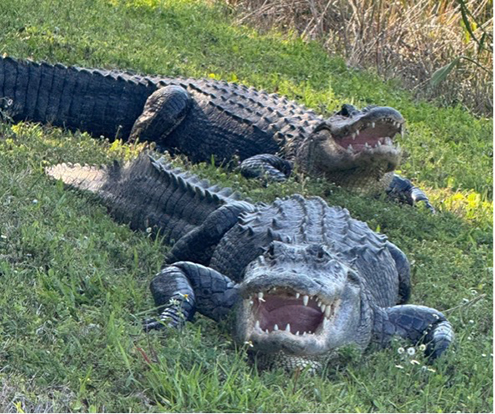
Alligators rely on sunshine and warm temperatures to regulate their body heat. That is why you often see them basking at the edge of ponds on cooler days, soaking in the sunlight. On a hot day you may see them lie in the sun with their mouths open. They are regulating their body temperature, not acting aggressive. Opening their mouths allows heat to escape so they don’t overheat.
Alligators are excellent swimmers. With their eyes, ears, and nostrils positioned on top of their heads, they can stay mostly hidden while watching the world around them. Alligators have a special third eyelid called a nictitating membrane that acts like built-in goggles, sliding over the eye to protect it and help them see while underwater.
Why do we see alligators in Verandah? The answer is simple: perfect habitat. Verandah was designed with nature in mind. Our ponds and preserves closely resemble the alligators’ natural home. They prefer freshwater habitats—ponds, wetlands, and rivers—all of which are part of our beautiful landscape. Add in abundant fish, turtles, birds, and other natural food sources, and it’s easy to see why alligators are comfortable calling Verandah home.
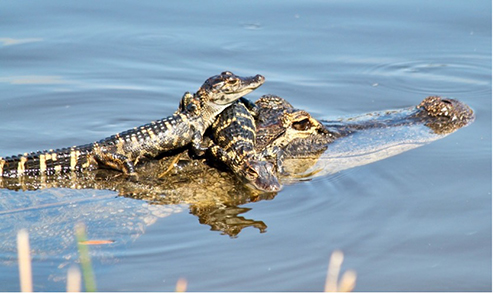
Sometimes we may even see small alligator babies along the edges of ponds or marshy areas such as the wetland along the powerline road. Female alligators build mound-shaped nests out of vegetation and soil and are attentive parents, unlike most reptiles. Once the eggs hatch, the tiny striped hatchlings—usually about 6 to 8 inches long—often stay close to their mother for many months. The babies make soft chirping sounds to communicate, especially when they feel threatened, and mom responds quickly. A protective mother alligator will defend her young, so it is especially important to keep your distance if you see babies. They may look cute and harmless, but where there are babies, a watchful—and very protective—mother is never far away. One day I was fortunate to see babies swimming alongside their mother, with two of them riding on her head!
You don’t need to live in fear of alligators, but you do need to live with respect for them. Alligators are generally shy and avoid humans. Most would much rather slide quietly into the water than encounter us. Problems usually arise when alligators lose their natural fear of people—most often because someone has fed them. A fed alligator learns to associate people with food, and that’s when they can become bold and potentially dangerous. So while fear isn’t necessary, awareness is essential.
Here are some common-sense guidelines we should all follow:
• Never feed an alligator—ever. It’s illegal and dangerous.
• Never throw sticks, stones, or anything else at an alligator. Harassing them is dangerous and illegal, and it can cause them to lose their natural fear of people.
• Keep a safe distance. Give basking alligators plenty of space on paths or shorelines. If you need to pass, turn around and choose another route rather than trying to walk close by.
• Keep dogs and children (and adults) away from the water’s edge.
• Don’t wade into ponds or wetlands for any reason.
• Be extra cautious at dawn, dusk, and night, when alligators are most active.
By observing from a distance, we protect both ourselves and the alligators. Remember—when people behave responsibly, alligators can remain wild and stay a valued part of our ecosystem.
Sharing Verandah with alligators connects us to the authentic Florida that many people only experience in parks or documentaries. These ancient reptiles were here long before neighborhoods, roads, or golf courses, and we are fortunate to coexist with them in their natural habitat. Watching an alligator glide across a pond or bask peacefully in the sun is a rare window into a world that has changed very little over millions of years. Encounters like these are not just everyday sights—they are privileges—so long as we enjoy them with caution, respect, and appreciation.
Ten Interesting Facts About Alligators:
1. Alligators don’t chew their food. They swallow chunks whole after tearing prey into pieces.
2. They can replace their teeth. An alligator may go through 2,000–3,000 teeth in its lifetime.
3. Alligators have pressure-sensing pits along their jaws. These tiny dark dots are sensory organs that detect vibrations and ripples in the water, helping them locate prey even in total darkness.
4. Their tails function like powerful propellers and energy storage units. An alligator’s muscular tail can propel it rapidly through the water and also stores fat reserves that help it survive periods with little food.
5. Their gender is temperature dependent. Warmer nest temperatures produce males; cooler ones produce females.
6. They communicate. Alligators hiss, grunt, bellow, and babies “chirp” to call their mothers.
7. They can hold their breath a long time. Alligators may stay underwater for up to an hour when resting.
8. They are fast in short bursts. On land they can lunge quickly but cannot sustain long chases.
9. Their eyes seem to glow at night. Shine a light across a pond after dark and you may see red “eye shine.”
10. Alligators are a major conservation success story. Once hunted nearly to extinction in the mid-1900s, they were protected under federal law and have now fully recovered, being removed from the endangered species list thanks to strong conservation efforts.