


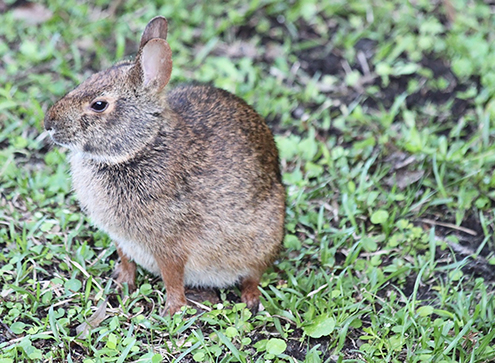
MARSH RABBITS
If you’ve ever caught a glimpse of a small, dark rabbit along a pond, preserve edge, or drainage area in Verandah, you may have met one of our most elusive residents—the marsh rabbit. We have two types of rabbits in Verandah- the eastern cottontail and the marsh rabbit. Unlike the larger, familiar eastern cottontail rabbits we frequently see around our homes, marsh rabbits are true wetland specialists, perfectly adapted to the watery landscapes that make Verandah such an ideal habitat for wildlife.
Marsh rabbits prefer areas with thick grasses, reeds, and low vegetation close to water. They’re most active at dawn and dusk, which is why you may spot them during early morning walks or while enjoying the quiet of the evening. With their compact bodies, short ears, short dark tails, and brown fur, they are well camouflaged against muddy banks and shadowy vegetation—blink, and they’re gone. Where I see them most frequently is near the bridge on the nature trail after the dog park.
What makes marsh rabbits especially interesting compared to the eastern cottontail species is how comfortable they are around water. Unlike most rabbits, marsh rabbits are strong swimmers. When threatened, they may slip silently into the water and paddle away. This skill helps them escape predators such as bobcats, hawks, and even snakes that share the same habitat.
Their diet reflects their marshy lifestyle. Marsh rabbits feed on grasses and aquatic plants, playing a quiet but important role in shaping wetland vegetation. By grazing selectively, they help maintain plant diversity and keep fast-growing plants from taking over.
Seeing a marsh rabbit in Verandah is a reminder that our community sits within a living ecosystem, not separate from it. These rabbits depend on healthy wetlands and undisturbed vegetation—features that Verandah has worked hard to preserve. Their presence is a sign that our ponds, preserves, and natural buffers are doing exactly what they’re meant to do: supporting native wildlife.
If you’re lucky enough to spot one, enjoy a glimpse from a distance. Marsh rabbits are shy and easily frightened, so it’s best not to approach them. You are most apt to see them during early morning and evening hours. Marsh rabbits may not get our attention like our alligators or wading birds, but their quiet lives and unique features make them just as interesting. If you spot a marsh rabbit in Verandah, consider it a quiet compliment from nature—these shy neighbors only thrive where wetlands are doing well.
10 INTERESTING FACTS ABOUT MARSH RABBITS
1. They are excellent swimmers. Unlike most rabbits, marsh rabbits will escape danger by slipping into the water and swimming to safety.
2. Wetlands are their home turf. Marsh rabbits live almost exclusively in marshes, swamps, and pond edges—not dry lawns or open fields.
3. They have shorter ears than eastern cottontails. Their small ears help reduce heat loss and snagging in dense, wet vegetation.
4. Their hind feet are broader than those of cottontails. This gives them better support on muddy, unstable ground and helps them push through shallow water and thick wetland plants.
5. Their bodies are more compact and heavier for their size. Compared to cottontails, marsh rabbits have a stockier build, which helps them conserve heat and move efficiently through dense marsh vegetation.
6. Their eyes are positioned high and to the sides of their heads. This gives marsh rabbits a wide field of vision- almost 360 degrees- so they can watch for predators while staying hidden in tall grasses.
7. They are most active at dawn and dusk. These quiet times help them avoid predators and human activity.
8. They don’t hop far when startled. Instead of long leaps, marsh rabbits make short, quick dashes into thick cover—or water. They also rely on frozen stillness as a defense strategy, sitting perfectly motionless until danger passes.
9. Their digestion is specialized for tough wetland plants. Marsh rabbits practice coprophagy (eating their soft droppings), allowing them to extract maximum nutrients by “re-eating” fibrous marsh grasses and aquatic plants—an efficient survival strategy in nutrient-poor wetland habitats.
10. Their fur is darker than most rabbits. The dark brown to blackish coat provides excellent camouflage in muddy, shadowed wetlands. It also has natural water-repellent qualities. Oils in their coat help shed water and keep their skin from becoming soaked when they swim or move through wet plants.