

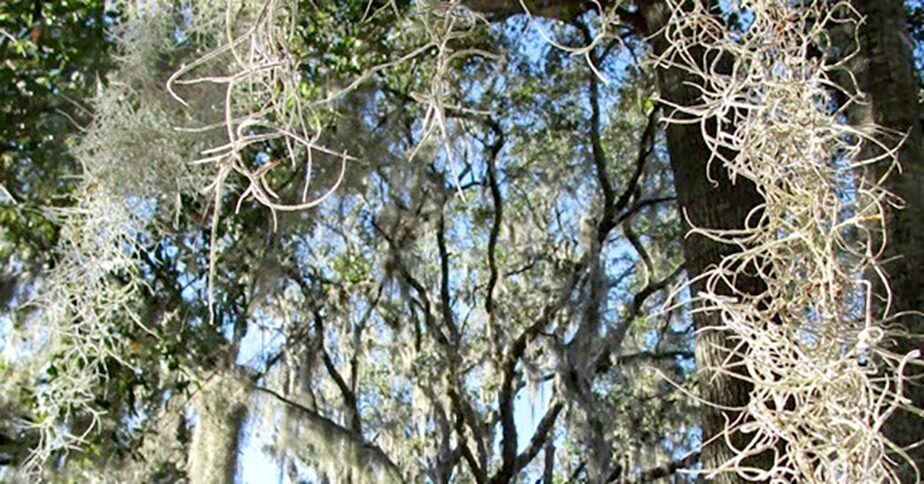
Spanish Moss (Tillandsia usneoides), a native to the tropical regions of South Florida, is a familiar sight throughout Verandah and humid areas of the south. Its curly, gray tendrils, reaching 5-20 feet, cling and drape from the branches of Live Oaks and Cypress trees, favorites of Spanish Moss. It can also attach to shrubs, fences, telephone poles and other such structures and plants.
Spanish Moss is not a moss nor is it Spanish, as its name implies. It is a flowering epiphyte or air plant and is a member of the bromeliad family, a relative of the pineapple. It was so named by French explorers who thought it resembled the beard of Spanish conquistadors. Over time, it gained other nicknames such as grandfather’s whiskers, graybeard and tree hair.
Spanish Moss does not have roots. As an epiphyte, it absorbs nutrients directly from air, rain and atmospheric moisture through its tiny, surface scales. Spanish moss will turn green after a heavy rain and then fade to gray as it dries. It can remain dormant during dry periods and will revive when moisture returns. Clean air and water are vital to the survival of Spanish moss. It will not thrive in polluted environments.
Spanish Moss propagates in two ways. The first and most common is by fragmented pieces called festoons that are carried off by wind or birds. The second is from very tiny seeds that have feathery appendages such as dandelions and blow through the air to another tree.
Epiphytes are often confused with parasites. Spanish moss is not parasitic as it does not live off the tree but lives on the tree, using it solely for support, a place to hang out, so to speak. It will not harm or kill the tree. However, heavy infestations can block sunlight from reaching leaves, interrupting photosynthesis and slowing the growth of the tree. Heavy growth typically occurs on declining trees where the canopy has thinned. Tree limbs can also break from the weight of Spanish Moss, particularly after a rainfall when it becomes saturated and heavy.
Throughout the ages people have found valuable uses for Spanish Moss. Indigenous people used it to construct clothing, frame and insulate houses, braid rope, fire pottery, and treat headaches to name a few. Confederate soldiers wove it into blankets. It was widely used for mattresses and stuffing for car seats. Factories existed throughout Florida that processed it to be used for such purposes. This all closed with the advent of foam rubber. Today Spanish Moss is largely used by the floral and arts & crafts industries.
More importantly, Spanish Moss plays an important role in Florida’s ecology. Several species of birds use it as a nesting material. Other species of animals use clumps of Spanish Moss for shelter including amphibians, reptiles, bats and insects. Spanish Moss is also used as a roosting site for the Zebra Longwing, Florida’s state butterfly. One word of caution. Chiggers, a biting insect, may be present on moss gathered from the ground or low hanging branches.
Spanish Moss gives Florida landscape a casual feel and is a definite trademark that makes Florida’s landscape unique. It not only has an aesthetic appeal, but it also has proven to be valuable resource to many. Ecologically, it provides shelter and habitat for wildlife.
As you ride or walk through the Verandah, look up and enjoy the marvels of Spanish Moss!