
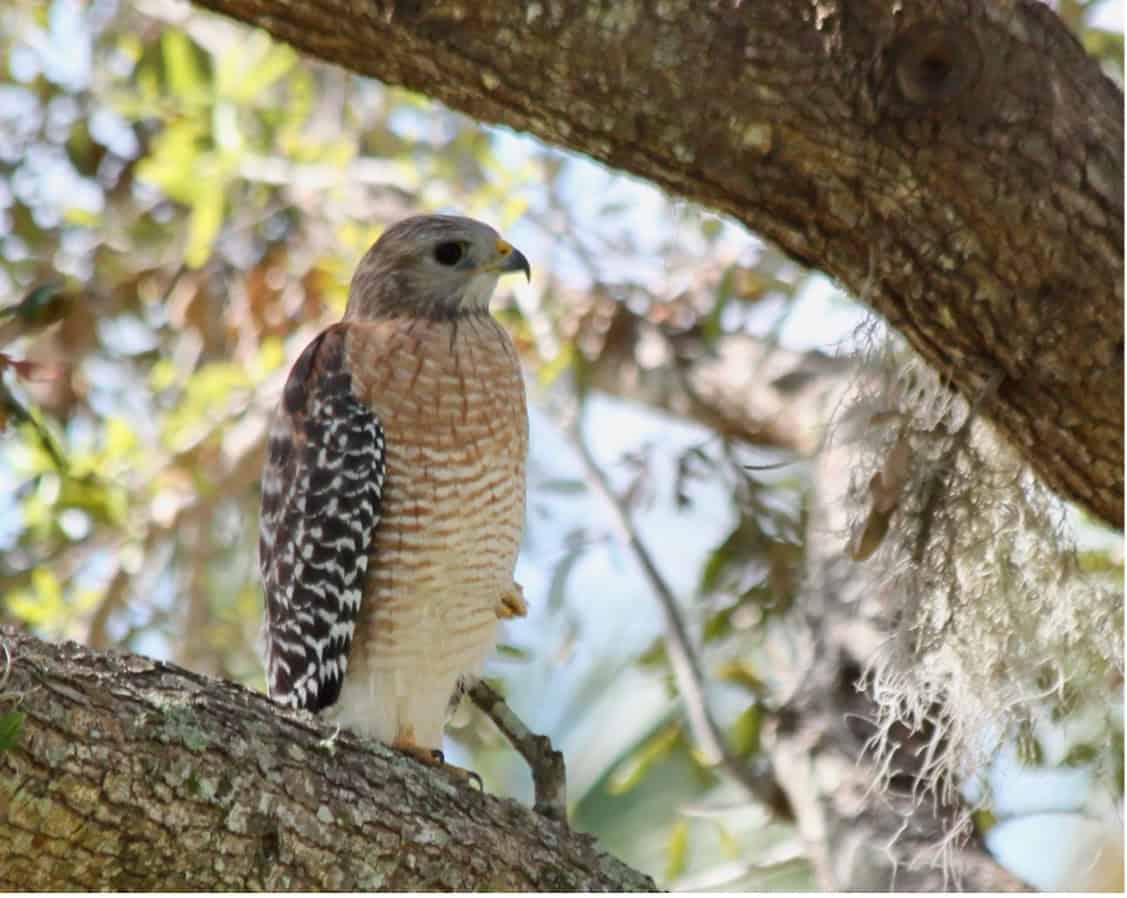
The Red-Shouldered Hawk: Verandah’s Watchful Predator
Soaring over the golf course, perched on a branch overlooking the ponds, or even resting atop your lanai, the Red-shouldered Hawk is a common sight in Verandah. A piercing whistle often signals the presence of one of Verandah’s most striking raptors. With sharp eyes trained on the ponds and woodlands below, this bird of prey is a masterful hunter and an essential part of our local ecosystem.
The Red-shouldered Hawk is medium-sized, with broad, rounded wings and a relatively long tail. Its name comes from the rich, rusty-red coloring on its upper wings, or “shoulders,” which contrast with its barred orange breast and black-and-white checkered wings. Its tail has bold black bands alternating with white, making it a striking silhouette when in flight.
Males and females share these vibrant colors, although females are slightly larger. Their keen eyesight is unmistakable—perfectly adapted for spotting prey from high vantage points. Juvenile hawks, on the other hand, have a more subdued appearance, with brown streaks on their chests and less distinct markings overall.
Red-shouldered hawks are known for their vocal nature, often letting out a sharp, repetitive “kee-ahh” call as they defend their territory or communicate with their mate. While Red-shouldered hawks are distinctive, they can sometimes be confused with other raptors spotted in Verandah, especially the Red-tailed Hawk, Cooper’s hawk, and Broad-Winged Hawk:
Red-Tailed Hawk:
• Red-tailed Hawks are larger and bulkier, with broader wings.
• Their tails are brick-red on the top in adults, unlike the red-shouldered hawk’s black-and-white banded tail.
• Red-tailed Hawks lack the checkered wing pattern and reddish shoulder patches that define red-shouldered hawks.
Cooper’s Hawk:
• Cooper’s hawks are smaller and sleeker, with shorter wings and longer tails that are rounded at the tip.
• Their plumage is more uniform, with a blue-gray back and a finely barred reddish chest, but they lack the bold checkering on the wings.
• In flight, Cooper’s Hawks exhibit a faster, more direct flight pattern, while red-shouldered hawks soar on thermals with slower wingbeats.
Broad-Winged Hawk:
• Broad-winged Hawks are smaller and more compact than red-shouldered hawks.
• They have a less vivid reddish chest and are more uniformly brown overall.
• Their tails have fewer, broader white bands compared to the sharply defined black-and-white pattern of the red-shouldered hawk.
Learning these subtle differences can help birdwatchers identify the red-shouldered hawk with confidence, whether it’s soaring above our community or perched in a nearby tree.
Ten Facts About the Red-Shouldered Hawk:
1. Red-shouldered hawks are year-round residents in Florida. They favor wooded wetlands, often nesting near water sources, which makes Verandah’s ponds and wooded areas an ideal home.
2. Their diet includes small mammals, birds, reptiles, amphibians, and even large insects like grasshoppers.
3. Red-shouldered hawks have multi-purpose wings. Their broad, rounded wings allow them to soar effortlessly over open areas and maneuver through dense woodlands with equal skill.
4. They are highly adaptable to urban and suburban environments in Florida. In Verandah you can often see them hunting in backyards, perched atop mailbox posts, or on the roof of the fitness center.
5. Red-shouldered hawks build large nests of sticks, often adding bark, moss, or leaves to line the inside. Pairs often reuse the same nesting site year after year, adding new material to refresh the nest.
6. Courtship involves aerial displays, where the male and female soar together and dive dramatically. Red-shouldered hawks mate for life. Both parents take part in raising the young, with the female primarily incubating the eggs and the male hunting for food. They will fiercely defend their nests, often diving at predators or intruders, including much larger birds like great horned owls.
7. Red-shouldered hawks can live over 10 years in the wild, with some individuals reaching their late teens.
8. Their call, a high-pitched “kee-ahh, kee-ahh,” is so distinctive that it’s often used in movies and TV shows to represent the generic “cry of a hawk.” They are also known to use their calls to scare prey into moving, making it easier to capture.
9. Red-shouldered hawks have incredibly sharp eyesight, up to eight times better than humans. This allows them to spot small prey like rodents or amphibians from high perches or even while soaring. Their eyes are also specially adapted to detect movement and see in color, which helps them identify camouflaged prey in dense forests.
10. The red-shouldered hawk plays a critical ecological role as a predator, particularly in controlling rodent populations. By preying on small mammals, these hawks help maintain a balance in the ecosystem, preventing rodent populations from exploding and potentially damaging Verandah’s landscape. In addition to rodents, red-shouldered hawks also feed on amphibians, reptiles, and insects, contributing to a broader regulation of species within their habitat. Their preference for hunting in forests and wetland areas makes them essential in these ecosystems, where they help stabilize food webs and keep prey species in check.
The Red-shouldered hawk is a master of its domain, gliding silently over Verandah’s landscapes or perched in watchful stillness. It serves as a reminder of the intricate web of life that thrives in our community. Next time you hear its sharp cry or catch a glimpse of its striking plumage, take a moment to appreciate the wild beauty of this magnificent raptor.
Their call, a high-pitched “kee-ahh, kee-ahh,” is so distinctive that it’s often used in movies and TV shows to represent the generic “cry of a hawk.”